
Chicken Coop Size Guide: How Much Space per Hen?
How big a chicken coop and run should be: commonly recommended space per hen, roosting length, nest boxes, ventilation, doors and how to size a walk-in coop.
The most common mistake new chicken keepers make is building a coop that is too small. Crowded hens are more stressed, more likely to peck at each other and harder to keep clean and healthy. The opposite mistake, a huge drafty coop for three birds, is less common but makes it harder for the hens to stay warm in winter. This guide gives you the widely used rules of thumb for sizing a coop and run, and the other details that matter as much as floor area.
Commonly recommended space per hen
There is no single official number, and recommendations vary between breeds, climates and sources. The figures below are widely used rules of thumb for backyard flocks of standard-size hens. Welfare standards and local regulations in some countries set their own minimums, so check what applies to you.
| Space | Standard hens (rule of thumb) | Bantams (rule of thumb) |
|---|---|---|
| Inside the coop | about 3-4 sq ft (0.3-0.4 m2) per bird | about 2 sq ft (0.2 m2) per bird |
| Outdoor run | about 8-10 sq ft (0.7-0.9 m2) per bird | about 4-5 sq ft (0.35-0.45 m2) per bird |
| Roost length | about 8-12 in (20-30 cm) per bird | about 6-8 in (15-20 cm) per bird |
| Nest boxes | about 1 box per 4-5 hens | about 1 box per 4-5 hens |
Large breeds need the upper end of these ranges or more. If your hens will be shut in the coop for long periods, for example in snowy winters, give them more indoor space.
Working through an example
Suppose you want 12 standard hens.
- Coop floor: 12 x 4 sq ft = 48 sq ft, so a coop of about 6 x 8 feet (roughly 1.8 x 2.4 m) or larger.
- Run: 12 x 10 sq ft = 120 sq ft, for example 8 x 16 feet (roughly 2.4 x 4.9 m).
- Roost: 12 x 10 in = 120 in, or about 10 feet of perch, which can be split over two or three bars.
- Nest boxes: 3.
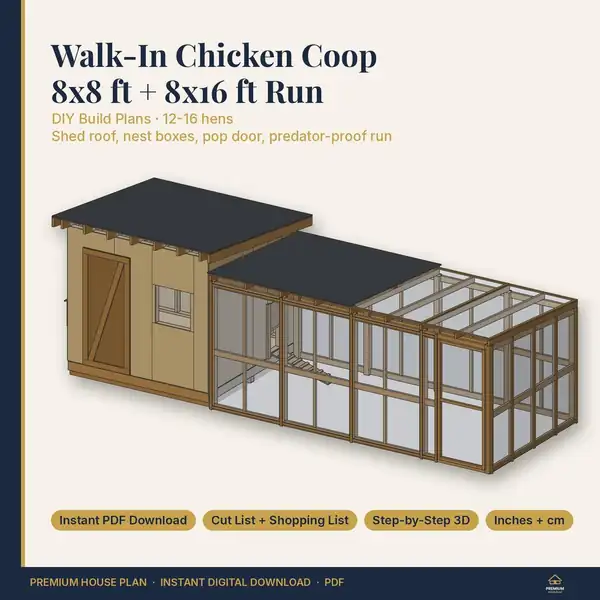
Our walk-in 8x8 coop with an 8x16 run is designed for 12 to 16 hens, which fits these rules of thumb: 64 sq ft of coop floor gives about 4 sq ft per bird at 16 hens, and the 128 sq ft run gives roughly 8 to 11 sq ft per bird across that range.
Plan for the flock you will have, not the one you start with
Chicken keeping tends to grow. Many keepers start with a few hens and add more later. If you have room, size the coop for a few more birds than you plan to keep now. It is much easier than building a second coop.
Roosts
Chickens sleep perched. Roost bars should be:
- higher than the nest boxes, so hens do not sleep in the nests
- wide enough to cover their feet; a flat 2x4 laid wide side up (about 3.5 in, or 89 mm) is a common choice
- spaced apart horizontally so birds on a higher bar are not directly above those on a lower one
- easy to remove for cleaning
Nest boxes
A nest box of roughly 12 x 12 inches (about 30 x 30 cm) suits most standard hens; larger breeds appreciate a bit more. Place boxes in a darker, quieter part of the coop, slightly raised off the floor, and line them with clean bedding. An external lid lets you collect eggs without entering the coop.
Ventilation
Good ventilation is essential all year round. Chickens produce a lot of moisture and ammonia from droppings, and damp air causes respiratory problems and frostbite in winter. Place vents high in the walls, above the roost height, so fresh air moves through without blowing directly on sleeping birds. Cover all vents and windows with sturdy wire mesh.
Protection from predators
Foxes, raccoons, dogs, rats, mink and birds of prey are threats depending on where you live. Practical measures include:
- strong welded wire mesh rather than light chicken wire, which keeps chickens in but does not keep predators out
- an apron of mesh buried or laid flat around the base of the run to stop digging
- a covered run where aerial predators or climbing animals are a problem
- secure latches that animals cannot open
- closing the pop hole every night, manually or with an automatic door
Walk-in coops vs raised hen houses
- Walk-in coops let you stand up inside to clean, collect eggs and handle birds. They are more comfortable to manage and suit larger flocks.
- Raised hen houses sit on legs with the run underneath. They are compact and suit small flocks and gardens, but cleaning means reaching in from outside.
Cleaning and access
Design the coop so it is easy to clean. A wide door, a smooth floor, a removable droppings board under the roosts and bedding that can be shovelled out quickly will save you time every week. Position the coop where you can reach it easily in all weathers, with water and power nearby if you plan to use heated waterers or lighting.
Siting the coop
Choose a well-drained spot with some shade in summer and shelter from prevailing winds. Check local rules: some areas limit the number of hens, ban roosters, or set minimum distances from neighbouring houses.
Building it yourself
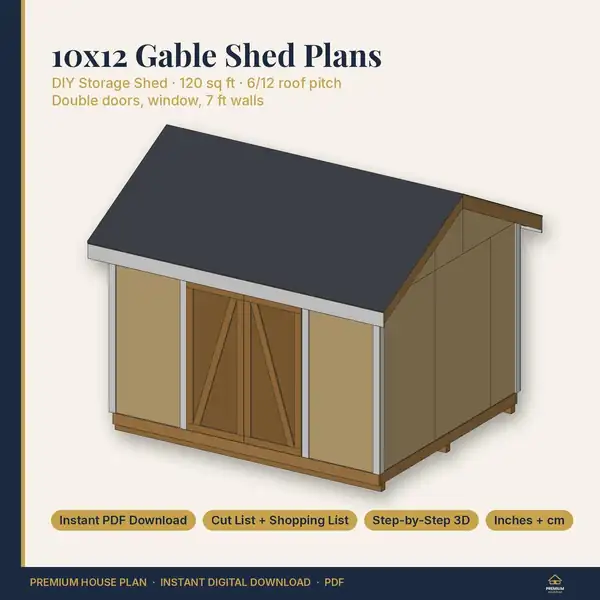
A coop is a natural next project after a shed: the same skills of foundation, framing and roofing apply. Our DIY shed building guide covers those basics. Our chicken coop plans are PDF plans with cut lists, shopping lists and 3D step-by-step views, with measurements in inches and cm.
Planning a walk-in coop? Every plan page lists exactly which files are included and shows the price before you buy.
Browse chicken coop plans All plansFrequently asked questions
How much space does a chicken need in a coop?
A widely used rule of thumb is about 3 to 4 sq ft (0.3 to 0.4 m2) of coop floor per standard hen, plus about 8 to 10 sq ft (0.7 to 0.9 m2) per hen in the run. Large breeds need more, bantams less.
How many nest boxes do I need?
Commonly about one nest box for every four or five hens. Hens often share favourite boxes, so you rarely need one per bird.
How many chickens fit in an 8x8 coop?
An 8x8 foot coop has 64 sq ft of floor. At about 4 sq ft per standard hen that is around 16 birds, provided the run is large enough as well.
Is chicken wire strong enough?
Chicken wire keeps hens in but many predators can tear through it. Welded wire mesh is a more secure choice for runs and vents.
Related categories
Plans related to this guide
More guides
How to Choose a House Plan for Your Plot
A step-by-step checklist for matching a house plan to your land: setbacks, coverage limits, plot width, slope, orientation, access and budget.
What's Included in a House Plan Set: PDF vs DWG vs DXF
What drawings a house plan set contains, what each sheet is for, and the practical differences between PDF, DWG and DXF files when you buy a plan online.
How Much Does It Cost to Build a 3 Bedroom House? The Cost Factors
What decides the cost of building a 3 bedroom house: size, shape, site, foundations, region, labour, finishes and fees, and how to get a reliable estimate.